Custom E-commerce Development Company: Get a Free Quote
Most online stores look fine until you actually try to run a business through them. The theme looks decent, the logo's in the right place, but then checkout feels clunky, the site crawls on mobile, and somehow every plugin update breaks something else. If that sounds familiar, you're not alone — and it's usually the point where business owners start looking into Custom E-commerce Development instead of patching things up again.
Worcco, a Pakistan-based digital agency working with clients across the globe, builds stores this way — from the ground up, around the actual business, not a theme marketplace template. Below is a practical look at what that process involves and how to get a free quote without the usual sales pitch.
Why "Custom" Actually Changes Things
Here's something most people don't realize until they've run a store for a while: not all e-commerce platforms are built the same way, and "customization" on a template often just means swapping colors and fonts. That's fine for a weekend side project. It falls apart once you're shipping internationally, running multiple payment gateways, or trying to sell something slightly unusual — subscriptions, bundles, digital licenses, whatever doesn't fit neatly into a standard "add to cart" box.
Custom E-commerce Development flips that process. Instead of squeezing your business into someone else's structure, the build starts with how you actually operate — your products, your customers, the weird edge cases nobody mentions until month three — and the store gets designed around that. Worcco treats every project this way as a Custom Website Development Agency: understanding the business first, then writing code, not the other way around.
Where Template Stores Usually Break Down
Shopify starter themes and basic WooCommerce setups are genuinely useful for testing an idea quickly. But give it six months of real growth and the cracks start showing:
- Pages slow down as the catalog grows: Database queries multiply, unoptimized theme assets accumulate, and TTFB crawls upwards.
- Checkout has too many steps: Excessive fields and redirects cause shoppers to abandon carts before completing payment.
- Plugins conflict with each other: Third-party dependencies clash with every minor core update, causing unexpected checkout breaks.
- Mobile performance tanks: Bloated scripts cause sluggish rendering on smartphones, where 70%+ of modern shoppers browse.
- Workarounds instead of features: Anything slightly custom — a product configurator, dynamic tier pricing, or loyalty perks — requires brittle third-party apps.
None of this is unusual. It's just what happens when a business outgrows a platform that was never meant to scale that far. Fixing it later almost always costs more than building it properly the first time through solid Ecommerce website development.
What You're Actually Paying For
People searching for a Custom E-commerce Development company often picture a slightly nicer version of what they already have. In practice, it's a completely different asset altogether:
- The platform fits the products, not the other way around: Physical goods, digital downloads, subscriptions, or some messy combination of all three — proper Custom E-commerce Development means the backend logic matches what you're actually selling instead of forcing it through a generic cart system.
- Checkout gets treated like it matters, because it does: Cart abandonment quietly kills more revenue than almost anything else in e-commerce. Good Ecommerce website development pays attention to the small stuff — fewer steps, upfront shipping costs, guest checkout, multiple payment options — because these tiny frictions add up fast.
- Speed isn't an afterthought: A lot of "custom" stores are really just a theme with five caching plugins bolted on. Real Ecommerce website development optimizes at the code level, which shows up directly in load times and Core Web Vitals scores.
- SEO is built in, not sprinkled on top: Clean URLs, proper schema for products, mobile-first layouts — a serious Custom Website Development Agency handles this during the build, not as a scramble after launch when rankings aren't moving.
- It can actually grow: Adding a few thousand SKUs, expanding into a new country, launching a loyalty program — a store built through solid Custom E-commerce Development should absorb that growth without needing a full rebuild every time something changes.
- It looks like your brand, not a template: Design should come from your actual identity, not a marketplace theme that a thousand other stores are also using.
Who Actually Needs This
Not every business needs the same kind of store, which is sort of the whole point of going custom in the first place. A few examples where Ecommerce website development makes a real difference:
- Fashion and apparel brands juggling complex size, cut, and color variants across visual-heavy, high-conversion product pages.
- Subscription-first businesses needing recurring automated billing, customizable delivery schedules, and a dedicated customer portal.
- B2B wholesalers requiring tiered bulk pricing, quote calculators, account approvals, and invoicing instead of standard retail checkout logic.
- Multi-vendor marketplaces handling independent vendor portals, automated commission splits, and separate shipping management.
- Digital product sellers requiring instant, encrypted, trackable asset delivery and software license generation.
Each of these needs a genuinely different technical setup, which is exactly why templates struggle once a business gets specific about what it sells.
The Cost of Waiting
A lot of business owners stick with a setup they already know, even when it's clearly holding them back, simply because switching sounds like a headache. But every week spent dealing with a slow product page or a checkout people abandon is money quietly walking out the door. It rarely announces itself as a crisis — it just shows up months later as flat sales and wasted ad spend.
This is usually around when people start actually searching for a Custom E-commerce Development company instead of another quick patch. And that instinct is usually right.
What Separates a Good Partner From a Template Reseller
Plenty of agencies advertise Ecommerce website development without delivering much beyond a reskinned theme. A few things worth checking before you sign anything:
- Do they actually ask questions before pitching a solution? A real Custom Website Development Agency wants to understand your products, fulfillment, and customers before recommending anything — not just grab your logo and get started.
- Can they explain their technical choices in plain language? If an agency can't tell you why they picked a particular platform, headless stack, or database framework for your Custom E-commerce Development project, that's worth noticing.
- Have they built something similar before? A fashion storefront and a B2B wholesale platform need completely different architectural approaches, so ask for relevant examples and live case studies.
- What happens after launch? Security updates, performance checks, ongoing database backups, and feature support matter just as much as the initial build itself.
- Is the pricing actually clear? Vague quotes usually mean vague expectations, unexpected change orders, and hidden costs later.
Why Worcco
This is roughly the bar Worcco holds itself to on every project. As a Pakistan-based agency working with clients worldwide, the team has built its reputation around doing Custom E-commerce Development properly — starting with real conversations, not assumptions about what a client probably wants.
What that looks like in practice:
- Discovery and planning before any design work starts, so the final build actually reflects how the business runs.
- Full Ecommerce website development, covering catalog structure, payment integration, checkout optimization, and everything in between.
- Design built around your brand, not recycled from a theme store or shared templates.
- SEO considered from the first wireframe, including structured product data and high Core Web Vitals, not added after the site's already live.
- App design for businesses that want a native or progressive mobile presence alongside their store.
- Transparent, competitive pricing that stays realistic without cutting corners on engineering quality.
- Support that continues after launch, because an online store needs active maintenance just like any physical retail space.
Worcco isn't trying to churn out identical-looking stores under the label of a Custom Website Development Agency. Each Custom E-commerce Development project gets treated as its own thing, because it is one.
How the Process Actually Works
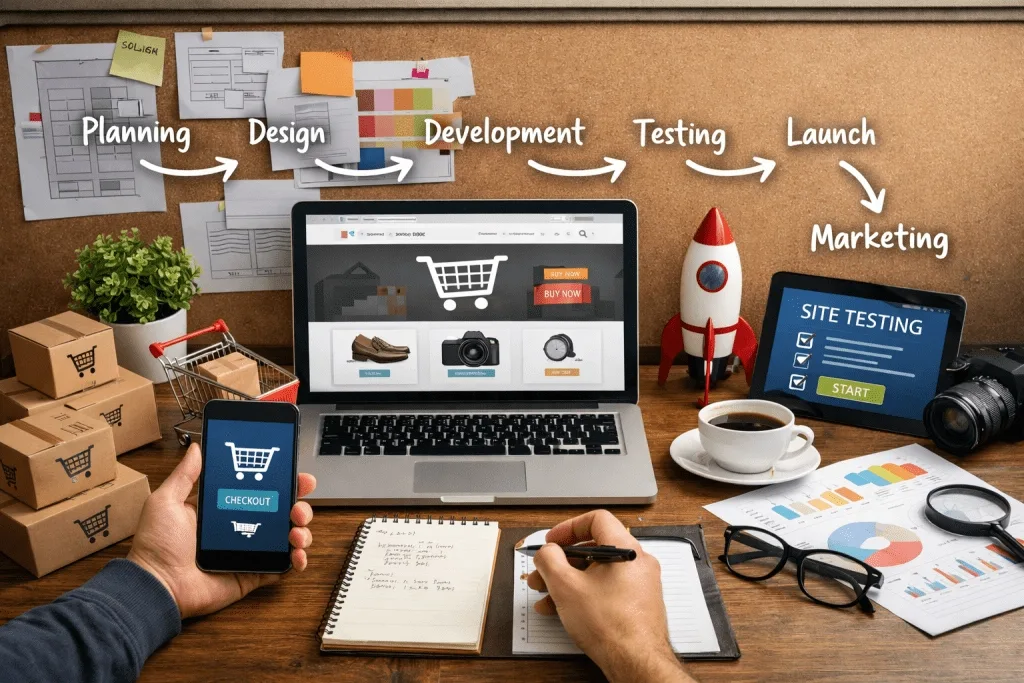
- Free consultation and quote: You explain your business model and current frustrations, and Worcco puts together a scoped quote based on what your project genuinely needs — not a flat package price.
- Discovery: The team digs into your catalog, customer journey, fulfillment pipelines, and technical requirements to map out the right architecture for the build.
- Design: UI/UX work begins, shaped around your brand identity and built with frictionless conversion in mind, not just visual polish.
- Development: The actual engineering — clean, modular code, resilient payment gateways, and lightning-fast performance baked in rather than bolted on later.
- Testing and launch: Every flow gets verified across devices, viewports, and browsers before anything goes live, so customers never encounter broken checkout buttons.
- Support: Maintenance, performance monitoring, and iteration continue after launch, since an e-commerce store's job evolves every day it is live.
Get a Free Quote
Here's the part worth repeating: you don't need to commit to anything just to find out what a custom build would cost. Worcco offers a free quote for every Custom E-commerce Development inquiry — no pressure, no aggressive sales follow-ups, and no fine print hiding extra fees.
Whether you're starting from scratch, migrating off a limited platform like basic Shopify or WooCommerce, or rebuilding something that's underperforming — a short conversation is usually enough to scope out a realistic price and timeline for the Ecommerce website development work involved.
That's intentional. Too many agencies push a one-size-fits-all package before they've actually understood the business behind the request. Worcco starts with listening, because any Custom Website Development Agency worth hiring should be able to explain why they're recommending a specific approach for your situation, not just a default one.
Request your free, no-obligation e-commerce quote →
A Few Common Questions
How long does a custom build usually take?
It depends on scope — a straightforward Custom E-commerce Development project might take 4 to 6 weeks, while a large enterprise store with multiple custom ERP integrations or B2B portals can run 2 to 4 months.
Is custom e-commerce more expensive than a template?
Upfront, usually yes. Over time, however, a well-built custom store almost always costs less than the ongoing patchwork a limited template eventually requires — especially once lost revenue from poor mobile speeds and abandoned checkouts is factored in.
Can an existing store be migrated over?
Yes. Migrating products, customer history, order records, and SEO rankings from a restrictive platform into a custom solution is one of the most common projects Worcco handles, executed with zero downtime or disruption to ongoing sales.
Does Worcco take on international clients?
Yes. The agency is based in Pakistan but works with clients across the United States, United Kingdom, Canada, UAE, Australia, and Europe, maintaining high communication standards and flexible overlap across time zones.
What platforms and frameworks does the team build on?
Whatever actually fits your business — Next.js headless storefronts, Shopify Plus custom themes, WooCommerce enterprise setups, or bespoke custom architectures. We don't push a single platform for every client; we choose based on what your specific operational needs demand.
Final Thoughts
If your current store feels more like a constraint than a growth driver, it's probably time to look into a real Custom E-commerce Development approach instead of another temporary fix. Templates are fine for testing an idea — but once scale becomes the goal, a tailored platform almost always wins out.
Worcco combines web development, design, SEO, and app design under one roof, making it a reliable partner for businesses that want their ecommerce development handled with the bigger picture in mind, not just the storefront in isolation.
If you're curious what a custom-built store could actually do for your business, reach out to Worcco for a free, no-obligation quote — and see what working with a genuine Custom Website Development Agency feels like when it's done right.
Contact Worcco — Let's Discuss Your Custom E-commerce Project
Industry Standards & Technical References
For official industry benchmarks, specifications, and guidelines on e-commerce engineering, refer to these authoritative resources:
- Google Web.dev Core Web Vitals for E-Commerce — Guidelines on site speed, responsiveness, and cumulative layout shift.
- Schema.org Product & Offer Specifications — Standardized structured data for rich search results.
- W3C WCAG Accessibility Guidelines — Ensuring digital storefronts are universally accessible.